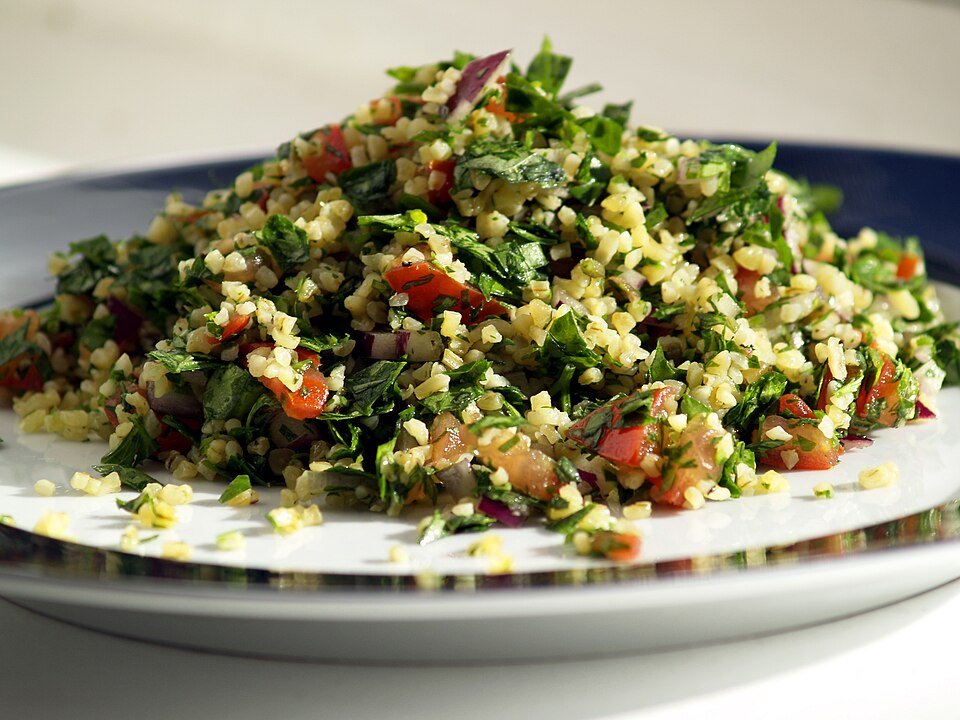
Ingredients
Metric weights use grams. US weights use ounces; liquids use fluid ounces. Conversions are rounded. Spoon measures use 5 ml teaspoons and 15 ml tablespoons; cups use 240 ml.
Serves 2
Main ingredients
Liquids
Seasoning and finishing
Equipment
Heatproof bowl; sieve; fork; large bowl; knife; board.
Check all product labels and cross-contact. Diet groups describe this listed recipe, not every substitution.
Steps
Soften the bulgur · About 30 min
- Put 50 g fine bulgur in the heatproof bowl.
- Pour 200 ml boiling water over the bulgur.
- Give the bulgur a 30-minute soak.
Check: A grain should be tender, without a hard centre.
- Drain the bulgur in the sieve.
- Press gently with the back of a spoon to remove excess water.
- Separate the grains with a fork.
Chop and combine · About 1 min
- Finely chop 50 g parsley and 50 g mint.
- Put the chopped herbs, 200 g finely diced tomatoes and 3 whole thinly sliced spring onions in the large bowl.
- Add the drained bulgur.
- Add the juice from 1 whole lemon.
- Pour in 3 tbsp olive oil.
- Add ¼ tsp salt.
- Turn the salad gently with a spoon.
- Serve at room temperature or chilled.
Tips
- Preparation can overlap with soaking; the listed total allows both separately.
- Use fine bulgur for this soaking method; coarse bulgur may require cooking.
Substitutions
- Use cooked quinoa instead of bulgur for a gluten-free adaptation.
Storage
- Get perishable Tabbouleh into the fridge within two hours, or within one hour above 32°C / 90°F. Eat Tabbouleh within two days, keeping it covered at 4°C / 40°F or colder.
- Bring cooked Tabbouleh to 74°C / 165°F, stirring or turning it for even heating. When Tabbouleh is part of the meal, serve cold salads, dips and chilled desserts straight from safe refrigeration.
Make ahead
- Wash and dry herbs ahead; mix close to serving.
FAQ
Is bulgur gluten-free?
No. It is wheat.
Why chop herbs finely?
Small pieces distribute the dressing and suit the salad texture.
How should I store tabbouleh?
Get perishable Tabbouleh into the fridge within two hours, or within one hour above 32°C / 90°F. Eat Tabbouleh within two days, keeping it covered at 4°C / 40°F or colder.
Recipe source and adaptation
Measured home adaptation: Good Food team: Tabbouleh.
Concise adaptation; quantities and method are stated.
Food safety references
FoodSafety.gov: cooking temperatures · Food Standards Agency: rice storage and reheating


